Residential lawn program (indicative)
What is a lawn care quote calculator?
A lawn care quote calculator estimates a monthly price for residential lawn service based on mowable turf area, the service program, and how difficult the property is to maintain. Lawn care and landscaping businesses use it to send fast, consistent quotes from a website form or CRM before an on-site visit, and homeowners use it to check whether a lawn mowing, fertilization, or aeration quote is in a reasonable range.
Residential lawn program (indicative)
Base program + acre-based service load
Embed this free calculator on your website—copy the snippet after signup and keep the Built with Calclet link for attribution (or upgrade to remove branding).
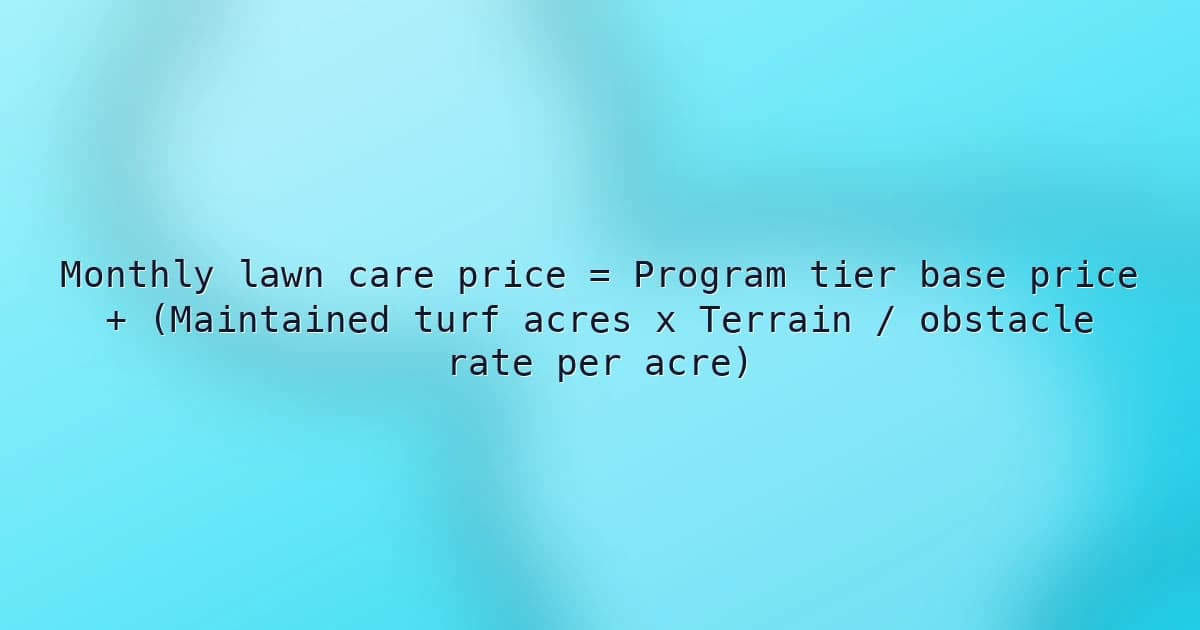
Lawn care pricing formula
The model starts with a base monthly price for the chosen program tier, then adds a per-acre charge that rises with slopes, obstacles, and landscaping detail. Larger and more complex lawns take more crew time, so they add more to the total.
Monthly lawn care price = Program tier base price + (Maintained turf acres x Terrain / obstacle rate per acre)- Program tiers: Essential mow and edge = $179, Plus weed and feed = $249, Premier aerate and overseed = $329 per month.
- Terrain rates: standard lot = $42 per acre, above-average complexity = $68 per acre, heavy landscaping or slopes = $105 per acre.
- 1 acre = 43,560 square feet, so a 0.35-acre lawn is about 15,250 square feet of mowable turf.
Inputs explained
Measure only the area that will actually be serviced and choose the tier and difficulty that match the real scope of work, so the estimate holds up after the on-site visit.
- Maintained turf acres
- Mowable grass area only, excluding the house, driveway, patios, garden beds, and wooded areas. Measure it with satellite tools such as Google Earth, county GIS maps, or lawn measuring software instead of the total lot size from the tax record, which can overstate turf by half or more.
- Program tier
- The service package: Essential covers mowing and edging, Plus adds fertilization and weed control, and Premier adds core aeration and overseeding. Choose the tier matching what the customer actually wants each month rather than quoting the base tier and adding treatments later.
- Terrain / obstacle factor ($ / acre)
- How hard the property is to service. Standard lots are open and flat with easy access; above-average properties have narrow gates, trees, and more trimming; heavy landscaping or slopes require push mowers, string trimmers, or extra safety time. Using the wrong level is the fastest way to underprice a job.
Example lawn care quote calculation
A homeowner with 0.35 acres of mowable turf, about 15,250 square feet, on a standard lot chooses the Essential mow and edge program. The quote is $179 + (0.35 x $42) = $193.70 a month, or about $44.73 per visit with weekly mowing. Upgrading the same lawn to the Plus weed and feed program on an above-average complexity lot raises the estimate to about $272.80 a month.
Put this calculator on your site
We'll copy this tool into your Calclet account—tweak branding and fields, then paste the embed on WordPress, Webflow, Shopify, or any HTML page. Every embed can link back to Calclet for discovery.
How to use the residential lawn program (indicative)
- Set maintained turf acres using the mowable area only, excluding driveway, patios, and non-serviceable landscaped zones.
- Choose the program tier that matches requested scope (for example mow-only versus weed-and-feed versus seasonal premium treatments).
- Select terrain or obstacle factor based on site complexity such as gates, slopes, tree density, and trim-intensive bed lines.
- Use the indicative monthly service total as an initial quote, then validate with on-site measurement and route-level minimums before final pricing.
Common lawn care quoting mistakes
- Quoting from total lot size instead of measured mowable turf area.
- Choosing the standard terrain level for properties with slopes, tight gates, or heavy bed edging.
- Ignoring drive time between stops, which makes isolated properties unprofitable at route prices.
- Pricing biweekly mowing at exactly half of weekly, even though longer grass takes more time to cut.
- Giving the regular price for an overgrown first cut instead of charging a one-time cleanup fee.
- Leaving fuel, equipment wear, insurance, and disposal fees out of the cost behind each quote.
- Never raising prices for existing customers while labor and fuel costs climb every season.
Residential lawn service pricing context
- Tiered service packaging in lawn care
- Operators commonly separate mowing-only, treatment-enhanced, and premium agronomic bundles to match homeowner budgets and seasonal needs.
- Property complexity as a labor multiplier
- Slopes, tight gate access, heavy bed edging, and obstacle density materially increase service time versus simple open turf layouts.
- Quote-to-final variance
- Pre-visit estimates often change after route fit, turf condition assessment, and add-on scope definition such as aeration, overseed, or irrigation checks.
FAQs
I was quoted about $194 a month for weekly mowing on a third-acre lawn—is that a fair price?
Break it down per visit. With weekly service averaging about 4.33 visits a month, $193.70 works out to roughly $44.73 per mow, including edging. Compare quotes on the same scope: whether trimming, blowing, and clipping removal are included, how often service happens, and whether the company is insured. Prices vary widely by region, so local quotes on the same scope are the best benchmark.
As a lawn care business owner, how do I make sure my quote covers labor, fuel, equipment, and profit?
Estimate your true cost per visit, including crew wages, payroll taxes, fuel, equipment wear, insurance, and overhead, then price with a target margin: price = cost / (1 - margin). If a visit costs $30 and you want a 35% margin, charge about $46.15. Also track revenue per crew hour on finished jobs; if a property consistently runs long, raise its terrain level or price.
How do I measure a customer's lawn size for a quote without visiting the property?
Use satellite measurement tools such as Google Earth, county GIS parcel maps, or lawn measuring software to outline only the mowable grass. Divide square footage by 43,560 to convert to acres; 15,000 square feet is about 0.34 acres. Confirm with a site visit or customer photos before the first service, and adjust if beds, slopes, or obstacles were not visible from above.
The lawn is overgrown and has not been cut in weeks—how should I price the first visit?
Charge a one-time cleanup fee on top of the regular program price. Tall or thick grass may need multiple passes, bagging, or a string trimmer, often taking two to three times as long as a routine cut. Quote it separately so the customer understands the first visit is different, then move them to the regular monthly rate once the lawn is under control.
A new customer is 25 minutes outside my usual route—how do I price it profitably?
Drive time is unpaid labor and fuel, so isolated properties need a higher price or a minimum charge per visit. Add a travel surcharge that covers round-trip crew time, or only accept the job if you can win neighboring properties on the same street. Many operators prioritize route density because several close stops earn more per hour than one large distant lawn.
We only mow eight months a year—how do I turn this into an even monthly bill?
Calculate the annual total and divide by the billing months. At $193.70 for eight service months, the year totals about $1,549.60, which works out to about $129.13 a month if billed in 12 equal payments. Year-round billing smooths cash flow for the business and the customer, but state clearly in the agreement which services are included and what happens if a customer cancels mid-season.
The customer wants biweekly mowing instead of weekly—should I charge half the price?
Usually not. Grass that grows for two weeks is longer and thicker, so each visit takes longer, produces more clippings, and wears equipment faster. Many operators charge more per visit for biweekly service, so the monthly total comes out to more than half the weekly price. During peak growing season, explain that biweekly cuts can leave the lawn looking rough between visits.
How do I price aeration, overseeding, or leaf cleanup for a customer on the basic mowing plan?
Either move them to a higher tier or quote add-ons separately. In this model, the Premier tier adds $150 a month over Essential for aeration and overseeding spread across the season. For one-time services like fall leaf cleanup or spring dethatching, price by estimated crew hours and disposal costs instead of folding them into the monthly rate.
Fuel and labor costs went up—how do I raise prices for existing lawn care customers without losing them?
Give 30 days' written notice before the new season, explain the cost increases briefly, and keep the increase modest and predictable, often a few percent a year rather than one large jump. Rerun this calculator with updated tier and terrain rates for new customers, and offer loyal customers a prepay or annual-contract discount to lock in their rate.
Can I use this calculator to quote commercial properties, HOAs, or lots larger than 4 acres?
Only as a rough starting point. Commercial and HOA bids usually price each visit or each season based on measured acres, equipment needed such as wide-deck mowers, trimming linear feet, and contract requirements like insurance limits and response times. Large or commercial properties are best bid from an on-site walk-through and actual crew hours.
Related calculators
Related guides
Step-by-step articles on building, embedding, and ranking calculator pages like this one.
Category: Home services pricing & field operationsTopics: Lawn care quoting, Service bundle pricing, Acreage-based estimates
Last reviewed: 2026-05-07
Reviewed by: Souhayb Kama Ldine