Net MRR snapshot (next month)
What is a net MRR change calculator?
A net MRR change calculator projects next month's monthly recurring revenue (MRR) from your current MRR, monthly churn rate, and net expansion rate. It shows whether existing customers are growing or shrinking revenue, before new sales, and converts the result into an ARR run rate. SaaS founders, RevOps teams, and finance leads use it to forecast MRR, test churn-reduction and upsell targets, and explain monthly revenue changes to investors.
Net MRR snapshot (next month)
Churn vs expansion as % of starting base
Embed this free calculator on your website—copy the snippet after signup and keep the Built with Calclet link for attribution (or upgrade to remove branding).
Net MRR change formula
Subtract the churn rate from 1, add the expansion rate, and multiply by starting MRR.
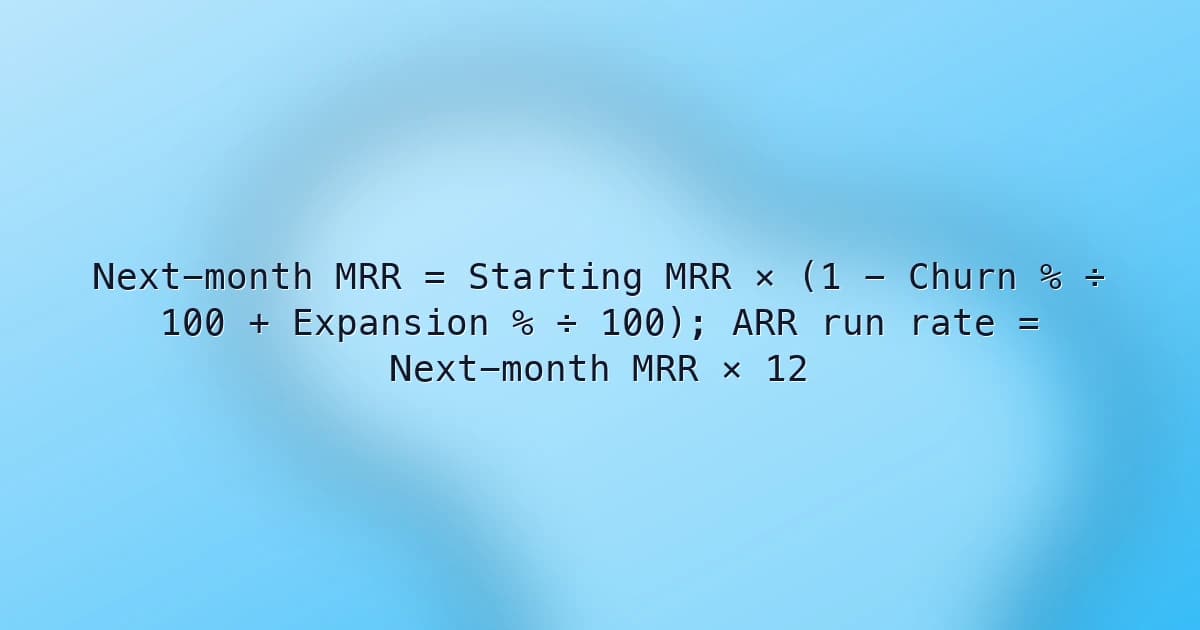
Next-month MRR = Starting MRR × (1 − Churn % ÷ 100 + Expansion % ÷ 100); ARR run rate = Next-month MRR × 12- Net MRR change = Starting MRR × (Expansion % − Churn %) ÷ 100.
- MRR after n months (constant rates) = Starting MRR × (1 − Churn % ÷ 100 + Expansion % ÷ 100)ⁿ.
- Annual churn from monthly churn = 1 − (1 − Monthly churn % ÷ 100)¹².
Inputs explained
The calculator applies both rates to starting MRR, so revenue-based churn gives a more accurate projection than customer-count churn.
- Starting MRR ($)
- Recurring subscription revenue at the start of the month. Exclude one-time fees and services revenue.
- Monthly logo churn (%)
- The share of MRR lost each month to cancellations. If small customers churn more than large ones, use revenue churn rather than the percentage of customers lost.
- Net expansion / upgrade (%)
- Monthly MRR growth from existing customers through upgrades, extra seats, and price increases, minus downgrades, as a percentage of starting MRR.
Example net MRR calculation
A SaaS company starts the month with $58,000 MRR, 2.25% monthly churn, and 4% net expansion. Next-month MRR = $58,000 × (1 − 0.0225 + 0.04) = $58,000 × 1.0175 = $59,015. That's a net gain of $1,015 from existing customers, and the ARR run rate is $59,015 × 12 = $708,180.
Put this calculator on your site
We'll copy this tool into your Calclet account—tweak branding and fields, then paste the embed on WordPress, Webflow, Shopify, or any HTML page. Every embed can link back to Calclet for discovery.
How to use the net mrr snapshot (next month)
- In Base MRR, input starting MRR ($) from your subscription analytics sink aligned to recognized recurring revenue, not booked ACV.
- In Churn & expansion, set monthly logo churn (%) using cancellations divided by starting logos unless your metric policy uses revenue churn instead.
- Set net expansion / upgrade (%) as uplift on the same base definition Finance uses for net retention bridges.
- Read projected next-month MRR and implied ARR run-rate; sanity-check against trailing three-month averages before publishing targets.
Common net MRR mistakes
- Using customer-count churn when large and small accounts churn at very different rates.
- Including new-customer MRR in the expansion rate.
- Counting upgrades without subtracting downgrades.
- Multiplying monthly churn by 12 instead of compounding it for annual churn.
- Projecting a single strong month's expansion rate for the whole year.
Net MRR motion benchmarks
- Monthly gross churn context
- SMB SaaS monthly logo churn often prints in the low single digits but swings by segment; enterprise motions trend lower while PLG volumes can spike churn numerators.
- Expansion versus contraction hygiene
- Net expansion percentages should match finance definitions—typically expansion minus contraction as a share of prior-period MRR when mirroring net retention bridges.
- Simple versus cohort models
- Single-period multipliers ignore cohort shape and in-quarter installs; board forecasts layer waterfall schedules when precision matters.
FAQs
What will our MRR be in 12 months if churn and expansion stay the same?
Compound the monthly multiplier. With $58,000 MRR, 2.25% churn, and 4% expansion, the multiplier is 1.0175. After 12 months, MRR ≈ $58,000 × 1.0175¹² ≈ $71,423 from existing customers alone. Rates rarely stay constant, so update the forecast monthly.
How much is cutting churn from 2.25% to 1.5% worth?
Next month's MRR rises from $59,015 to $59,450, a gain of $435. Compounded over 12 months, MRR reaches about $78,004 instead of $71,423, roughly $6,580 more MRR, or about $78,960 more ARR run rate.
What is 2.25% monthly churn as an annual churn rate?
Compound it rather than multiplying by 12. Annual churn = 1 − (1 − 0.0225)¹² ≈ 23.9%, not 27%. Losing nearly a quarter of starting revenue each year means expansion and new sales must cover that gap just to stay flat.
How much expansion do we need to grow MRR 2% a month with 3% churn?
Net growth = expansion − churn, so you need 3% + 2% = 5% monthly net expansion. On $58,000 MRR, that's $2,900 of upgrades and seat adds every month, against $1,740 lost to churn.
How long until we reach $100,000 MRR from existing customers alone?
Divide the logarithms: months = ln($100,000 ÷ $58,000) ÷ ln(1.0175) ≈ 31.4. At 1.75% net monthly growth, it takes about 32 months without new customers. Adding new sales shortens this considerably.
Our churn is higher than expansion—how fast are we shrinking?
With 5% churn and 2% expansion on $58,000, next month's MRR drops to $56,260, a loss of $1,740. If that continues, MRR falls to about $40,243 in 12 months. Fix churn first, because new sales will mostly replace lost revenue.
How do I add new-customer MRR to this forecast?
Add new MRR after applying churn and expansion. If you also win $3,000 of new MRR, next month's total is $59,015 + $3,000 = $62,015, and the ARR run rate is $744,180. Keeping new sales separate shows how much growth comes from existing customers.
Should I use customer churn or revenue churn in this calculator?
Revenue churn usually gives a more accurate result, because the formula applies churn to MRR. If 2.25% of customers cancel but they're small and represent only 1.2% of MRR, next month is $59,624 rather than $59,015. Using customer churn would understate the forecast by $609.
What annual net revenue retention does 1.75% monthly net growth imply?
If the rates hold steady for the same customers, 1.0175¹² ≈ 123.1% annual net revenue retention. In practice, expansion often slows as accounts mature, so check this against your actual 12-month retention by customer group.
Why is ARR run rate just next month's MRR times 12?
The run rate annualizes the current monthly figure for quick comparison. $59,015 × 12 = $708,180. It assumes MRR stays flat for a year and ignores future churn, expansion, and seasonality, so don't treat it as a revenue forecast.
Related calculators
Related guides
Step-by-step articles on building, embedding, and ranking calculator pages like this one.
Category: SaaS MRR forecastingTopics: Net MRR bridge, Monthly logo churn, Expansion rate
Last reviewed: 2026-05-07
Reviewed by: Souhayb Kama Ldine