Boarding revenue (base)
What is a pet boarding revenue calculator?
A pet boarding revenue calculator estimates how much lodging revenue a dog kennel, cat boarding facility, or pet hotel will earn from booked pet-nights and the average nightly rate, with an optional holiday or peak-season surcharge. Boarding business owners, managers, and people planning to open a kennel use it to forecast monthly revenue, test pricing changes, and plan for busy holiday periods.
Boarding revenue (base)
Pet-nights × rate × seasonal uplift
Embed this free calculator on your website—copy the snippet after signup and keep the Built with Calclet link for attribution (or upgrade to remove branding).
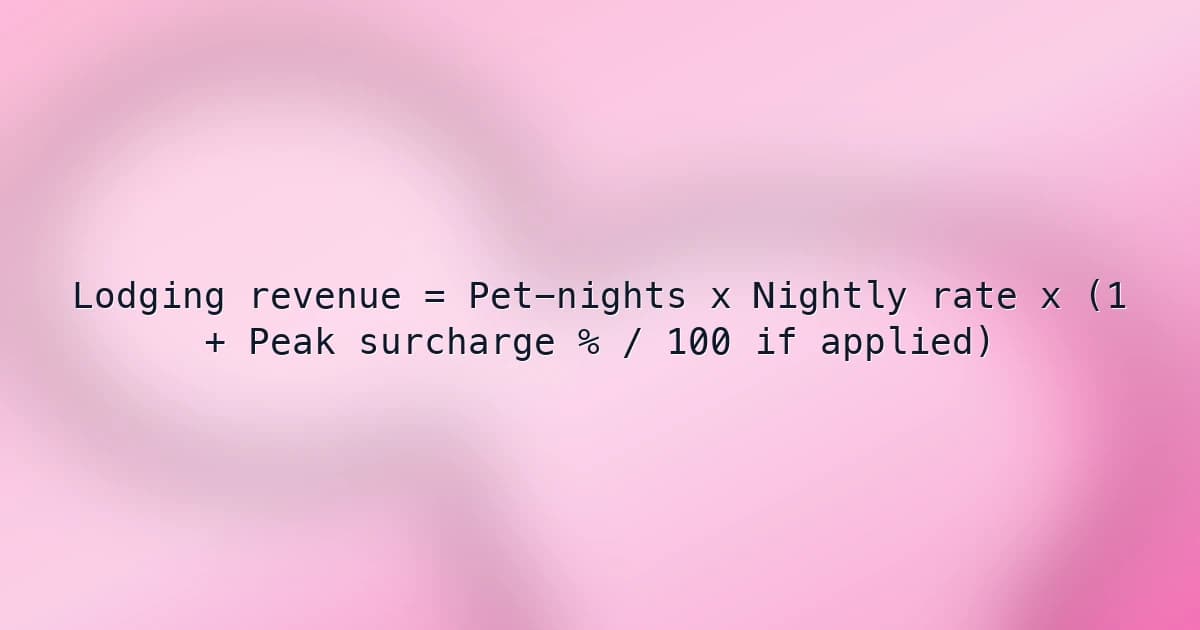
Pet boarding revenue formula
Multiply the number of pet-nights by the blended nightly rate. If peak-season pricing applies, increase the result by the surcharge percentage.
Lodging revenue = Pet-nights x Nightly rate x (1 + Peak surcharge % / 100 if applied)- Pet-nights = Number of pets boarded x Nights each stayed.
- Occupancy rate (%) = Pet-nights booked / (Number of runs or suites x Nights in period) x 100.
- Add daycare, grooming, baths, playtime, and retail separately to get total revenue.
Inputs explained
Use booking data from your kennel software for the period you want to forecast.
- Total pet-nights / period
- The total number of nights pets stay overnight. Two dogs boarding for 5 nights count as 10 pet-nights. Use your check-in and check-out rules consistently.
- Blended nightly rate ($)
- Your average nightly price across standard runs, larger suites, and cat condos after multi-pet and loyalty discounts. Using the actual average from past invoices is more accurate than your published price list.
- Apply peak-season surcharge
- Turn this on to model holiday and summer periods when you charge a premium for high demand, extra staffing, or minimum stays.
- Peak surcharge (%)
- The percentage added to the nightly rate during peak periods. An 18% surcharge on a $58 rate makes the holiday rate about $68.44.
Example pet boarding revenue calculation
A boarding facility books 420 pet-nights in a month at a $58 average nightly rate, earning 420 x $58 = $24,360 in lodging revenue. With an 18% peak-season surcharge, the same bookings earn about $28,744.80. With 30 runs available, 420 pet-nights is about 46.7% occupancy, so there is room to grow before adding capacity.
Put this calculator on your site
We'll copy this tool into your Calclet account—tweak branding and fields, then paste the embed on WordPress, Webflow, Shopify, or any HTML page. Every embed can link back to Calclet for discovery.
How to use the boarding revenue (base)
- Input total pet-nights for the period using your kennel definition for check-in and check-out nights.
- Enter blended nightly rate ($) that reflects your weighted mix of kennel sizes, suite tiers, and standard discounts.
- Toggle apply peak-season surcharge when modeling holiday windows, then set peak surcharge (%) to match published holiday rate cards.
- Review estimated lodging revenue for base boarding, then layer daycare, grooming, and retail add-ons outside this wizard scope.
Common pet boarding revenue mistakes
- Using the published nightly price instead of the average rate after discounts.
- Counting stays or pets instead of pet-nights.
- Forecasting every month at the same occupancy when summer and holidays are much busier.
- Not charging a holiday surcharge even though staffing costs rise.
- Ignoring cancellations and no-shows during peak periods without deposits.
- Leaving out add-on services like baths, playtime, and daycare that can add meaningful revenue.
Pet boarding revenue modeling context
- Pet-night counting convention
- Operators typically multiply occupied runs by nights boarded so partial stays and same-day turnover rules materially affect totals.
- Blended nightly rate behavior
- Mixed SKUs like standard versus suite boarding compress into one blended average for planning, while POS detail stays granular for margin analysis.
- Peak-season surcharge practice
- Holiday windows often carry premium pricing tied to demand spikes, staffing overtime, and extended operating hours.
FAQs
How much revenue can my dog boarding business make per month?
Multiply runs by nights in the month and your expected occupancy, then by your average rate. With 30 runs in a 30-day month, capacity is 900 pet-nights. At 420 pet-nights (about 46.7% occupancy) and $58 a night, lodging revenue is $24,360. At 75% occupancy (675 pet-nights), revenue would be about $39,150.
Should I raise my nightly boarding rate, and how many bookings can I afford to lose?
Raising the rate from $58 to $63 on 420 pet-nights increases revenue from $24,360 to $26,460, an extra $2,100 a month. You would need to lose about 33 pet-nights (about 7.9%) before revenue falls below today's level. If you are often fully booked, a rate increase is usually safer.
How much should I charge for holiday boarding?
Many facilities add a holiday surcharge of roughly 10% to 25% to cover high demand and extra staff pay. An 18% surcharge on a $58 rate is about $68.44 a night. If 30 runs are 95% full over a 10-day holiday period, that is about 285 pet-nights and roughly $19,505 in lodging revenue.
How do I forecast annual boarding revenue with busy and slow seasons?
Forecast peak and regular months separately. With 9 regular months at $24,360 and 3 peak months at 600 pet-nights, $58 a night, and an 18% surcharge (about $41,064 each), annual lodging revenue is about $342,432. Use last year's monthly bookings to set realistic peak and off-peak occupancy.
How much extra revenue can add-on services bring in?
Add-ons can meaningfully increase revenue per stay. With 420 pet-nights and an average 4-night stay (about 105 stays), offering a $25 bath at checkout to 30% of stays adds about $787.50. Selling $10 playtime sessions on 40% of pet-nights adds about $1,680. Together that is about 10% more than lodging alone.
How much do multi-pet discounts cost my boarding business?
Estimate how many pet-nights get the discount. If 25% of 420 pet-nights are additional pets from the same household with a 10% discount at $58, the discount costs about $609 a month. Multi-pet discounts can win loyal family customers; just include them in your blended rate so forecasts stay accurate.
How much revenue do holiday cancellations and no-shows cost?
Multiply cancelled pet-nights by the holiday rate. If 10% of 285 holiday pet-nights cancel late (about 28.5 nights) at $68.44, you lose about $1,951, often with no time to rebook. Many facilities require non-refundable deposits or minimum stays for holidays to protect this revenue.
What occupancy rate should a pet boarding facility aim for?
It varies with location and season. Holidays and summer often run near full, while some off-peak weeks may be well under half full. Track monthly occupancy (pet-nights booked divided by runs times nights) and focus marketing, daycare promotions, and loyalty offers on slower periods rather than adding capacity.
How do I calculate pet-nights for multi-pet families and partial stays?
Count each pet for each overnight stay. Two dogs staying 5 nights equal 10 pet-nights. For late check-outs or early drop-offs, follow your billing policy, such as charging a full night after a certain checkout time, and count pet-nights the same way you bill so revenue forecasts match invoices.
Is boarding revenue the same as profit?
No. Revenue is before costs such as staff wages, rent, utilities, food, cleaning supplies, insurance, and software. Labor is often the largest cost, especially during holidays. Estimate your costs per pet-night and subtract them from revenue to see whether your pricing and occupancy are actually profitable.
Related calculators
Related guides
Step-by-step articles on building, embedding, and ranking calculator pages like this one.
Category: Pet services revenue planningTopics: Kennel and boarding revenue, Pet-night forecasting, Seasonal boarding pricing
Last reviewed: 2026-05-07
Reviewed by: Souhayb Kama Ldine