Monthly gross booking revenue
What is a short-term rental income calculator?
A short-term rental income calculator estimates how much gross revenue an Airbnb, Vrbo, or vacation rental property can earn in a month. It multiplies your average nightly rate by booked nights and can add cleaning fees collected from guests. Hosts, property investors, and vacation rental managers use it to evaluate a property before buying, set nightly rates, compare short-term and long-term rental income, and plan for seasonal swings.
Monthly gross booking revenue
ADR × booked nights + optional cleaning
Embed this free calculator on your website—copy the snippet after signup and keep the Built with Calclet link for attribution (or upgrade to remove branding).
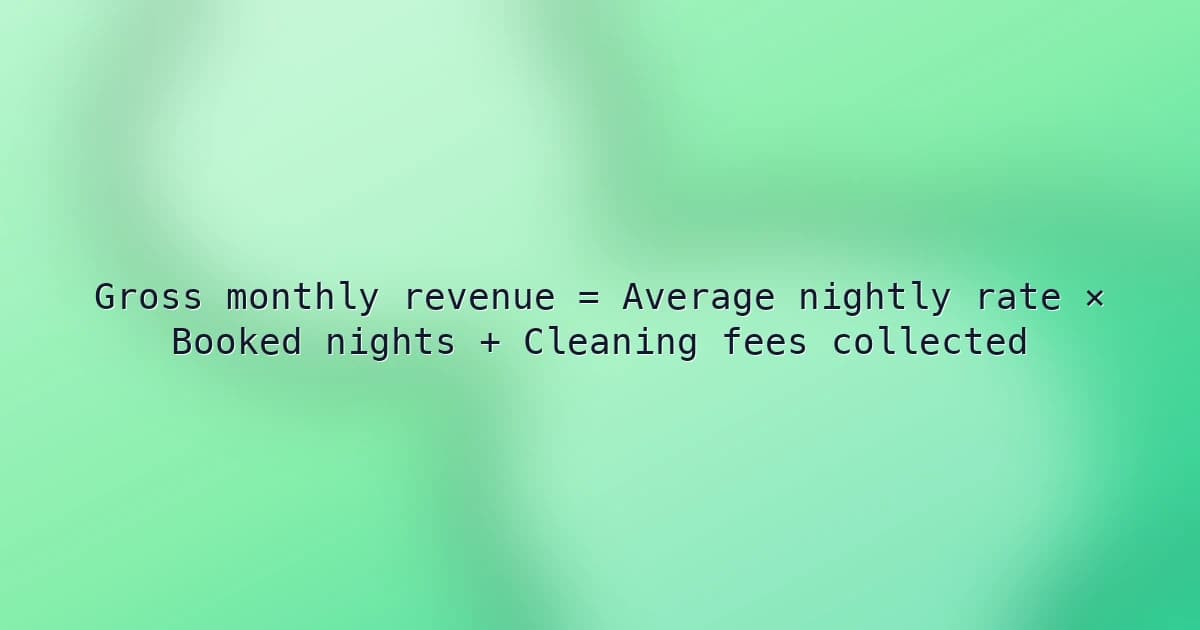
Short-term rental income formula
Multiply average nightly rate by booked nights, then add any cleaning fees collected.
Gross monthly revenue = Average nightly rate × Booked nights + Cleaning fees collected- Occupancy rate = Booked nights ÷ Available nights × 100.
- Revenue per available night (RevPAR) = Nightly revenue ÷ Available nights in the month.
- Gross revenue is before platform fees, cleaning costs, taxes, and other expenses; subtract those for net income.
Inputs explained
Use realistic averages across weekdays, weekends, and seasons rather than your best month.
- Average nightly rate ($)
- Average price guests pay per night, before platform fees and taxes. Include weekday and weekend rates in the average.
- Booked nights / month
- Nights booked by guests in the month, excluding owner stays and maintenance blocks.
- Add flat cleaning fee / month
- Check this box to include cleaning fees collected from guests in gross revenue.
- Cleaning fee collected ($ / mo)
- Total cleaning fees collected in the month. If you charge per stay, multiply the fee by the number of stays.
Example short-term rental income calculation
A city apartment rents for an average of $185 a night and is booked 18 nights in a month. Nightly revenue = $185 × 18 = $3,330, a 60% occupancy rate in a 30-day month. Adding $165 of cleaning fees brings gross revenue to $3,495. At this pace, nightly revenue is about $39,960 a year.
Put this calculator on your site
We'll copy this tool into your Calclet account—tweak branding and fields, then paste the embed on WordPress, Webflow, Shopify, or any HTML page. Every embed can link back to Calclet for discovery.
How to use the monthly gross booking revenue
- In Calendar, input average nightly rate ($) from channel calendars net of coupons only if that matches how you define ADR internally.
- Input booked nights per month using reservation counts aligned to check-in dates minus owner blocks.
- In Fees, toggle flat cleaning fee collection and input dollars only when guests pay predictable monthly linen turnovers.
- Read estimated gross monthly revenue and compare shoulder-season scenarios before underwriting debt coverage.
Common short-term rental income mistakes
- Projecting peak-season rates and occupancy for the whole year.
- Treating gross revenue as profit before platform fees, cleaning, and utilities.
- Counting cleaning fees in both the nightly rate and the cleaning fee line.
- Double-counting nights booked across Airbnb and Vrbo.
- Forgetting local lodging taxes and short-term rental rules.
STR revenue planning context
- ADR versus payout
- Average nightly rate should mirror guest-paid ADR before OTA commissions unless you intentionally model net payouts inside rate inputs.
- Occupancy realism
- Destination markets swing seasonally; anchor booked nights per month on trailing twelve-month occupancy bands rather than peak-week snapshots.
- Fee stacking clarity
- Cleaning and resort-style fees vary by platform presentation—keep them consistent month-to-month when trending gross booking revenue.
FAQs
How many nights do I need to book to cover my monthly costs?
Divide monthly costs by what you keep per night. If 15% goes to platform fees and booking costs, a $185 night nets about $157.25. Covering $2,800 of mortgage, utilities, and supplies takes $2,800 ÷ $157.25 ≈ 17.8, so 18 booked nights, or about 59% occupancy.
Should I raise my nightly rate or lower it to get more bookings?
Compare total revenue. Raising the rate 10% to $203.50 but losing 2 nights gives $3,256, less than $3,330 today. Dropping to $165 and filling 22 nights gives $3,630. Test pricing changes and watch occupancy, since more nights also means more cleaning and wear.
What nightly rate do I need to earn $4,000 a month?
Divide the target by booked nights. At 18 nights, you'd need about $222 a night. At $185 a night, you'd need about 22 booked nights. Check comparable listings in your area to see whether either is realistic.
How much will my Airbnb make in a year?
Estimate high and low seasons separately rather than multiplying one month by 12. A peak month of 26 nights at $240 brings in $6,240, while an off-season month of 10 nights at $140 brings in $1,400. A steady 18 nights at $185 would be about $39,960 a year, but seasonal markets rarely look that even.
Is short-term rental more profitable than renting long term?
Compare net income, not gross. $3,330 of short-term revenue with about 35% going to fees, cleaning, utilities, and supplies nets about $2,165. A $2,400 long-term rent with about 8% in costs nets about $2,208. Short-term rentals often earn more gross revenue but need more work and carry more risk.
What is my occupancy rate and revenue per available night?
Divide booked nights by nights in the month. 18 booked nights in a 30-day month is 60% occupancy. Revenue per available night is $3,330 ÷ 30 = $111, a useful figure for comparing your listing with others in the market.
How should I enter cleaning fees charged per stay?
Multiply the fee by the number of stays. If you host 6 stays in a month and charge $85 each, enter $510 of cleaning fees. Remember the cleaning fee usually goes toward paying your cleaner, so it isn't profit.
Does this calculator subtract Airbnb or Vrbo fees?
No. It shows gross revenue before platform fees. Fee structures differ by platform and fee model, so check your host dashboard and subtract the actual percentage from your payouts to estimate net income.
Are lodging or occupancy taxes part of my rental income?
Usually not. Occupancy and lodging taxes are collected from guests and paid to local or state authorities, and platforms collect and pay them for hosts in many areas. Leave them out of gross revenue and check your local rules.
How do I avoid overestimating booked nights across multiple platforms?
Count each night only once. If a property is listed on Airbnb and Vrbo, combine bookings from both calendars and remove any overlap. A month can't have more booked nights than the nights available.
Related calculators
Related guides
Step-by-step articles on building, embedding, and ranking calculator pages like this one.
Category: Short-term rental revenue modelingTopics: STR gross revenue, Average daily rate, Booked nights
Last reviewed: 2026-05-07
Reviewed by: Souhayb Kama Ldine