Net profit after tax
What is profit after tax?
Profit after tax, also called net profit after tax (NPAT) or net income, is what a business keeps after paying income tax on its pre-tax profit. It's the bottom-line number used to judge profitability, plan owner distributions or dividends, repay debt, and reinvest in growth. Business owners, accountants, and finance teams calculate profit after tax to set budgets, estimate tax bills, and compare how different tax rates or deductions affect the money left over.
Net profit after tax
Pre-tax profit x (1 - tax rate)
Embed this free calculator on your website—copy the snippet after signup and keep the Built with Calclet link for attribution (or upgrade to remove branding).
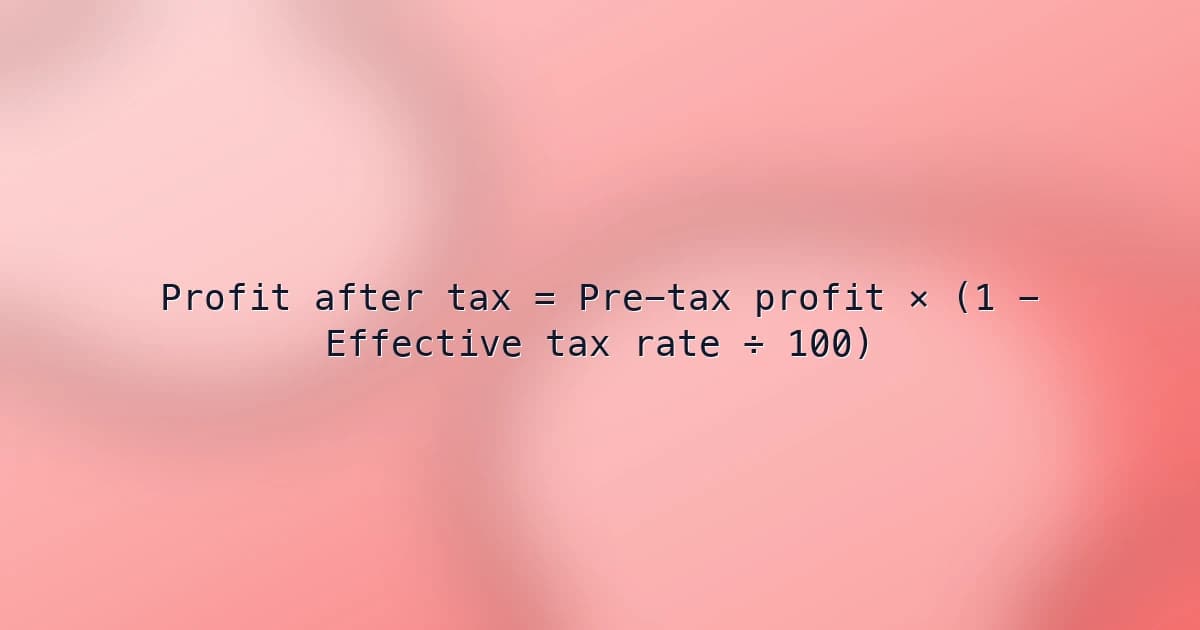
Profit after tax formula
Multiply pre-tax profit by one minus the effective tax rate.
Profit after tax = Pre-tax profit × (1 − Effective tax rate ÷ 100)- Estimated tax = Pre-tax profit × Effective tax rate ÷ 100.
- Pre-tax profit needed for an after-tax target = Target after-tax profit ÷ (1 − Effective tax rate).
- Net profit margin = Profit after tax ÷ Revenue × 100.
Inputs explained
This calculator gives a planning estimate. Actual tax depends on your business structure, location, deductions, and credits, so confirm with a tax professional.
- Pre-tax profit ($)
- Profit before income tax: revenue minus all deductible expenses, including cost of goods sold, operating expenses, interest, and depreciation. It's often called earnings before tax (EBT).
- Effective tax rate (%)
- The share of pre-tax profit you actually pay in income tax, combining federal, state, and local taxes after deductions and credits. It's usually different from the headline statutory rate.
Example profit after tax calculation
A business earns $185,000 in pre-tax profit and has an effective tax rate of 24%. Estimated tax is $185,000 × 0.24 = $44,400, so profit after tax is $185,000 − $44,400 = $140,600. On $1.2 million in revenue, that's a net profit margin of about 11.72%. To keep $200,000 after tax at the same rate, the business would need about $263,158 in pre-tax profit.
Put this calculator on your site
We'll copy this tool into your Calclet account—tweak branding and fields, then paste the embed on WordPress, Webflow, Shopify, or any HTML page. Every embed can link back to Calclet for discovery.
How to use the net profit after tax
- Input pre-tax profit ($) from operating income or another EBIT-level baseline consistent with your modeling scope.
- Set effective tax rate (%) using historical blended ETR guidance or scenario assumptions for future tax posture.
- Review after-tax profit and estimated tax amount to sanity-check scaling versus revenue and margin plans.
- Run sensitivity cases by moving effective tax rate bands when evaluating jurisdictional expansion or credit eligibility.
Common profit after tax mistakes
- Using the headline statutory tax rate instead of your effective tax rate.
- Forgetting state and local income taxes, or adding them without accounting for federal deductibility.
- Treating cash flow as profit—loan principal payments aren't deductible, but they still need after-tax cash.
- Assuming a loss year produces an immediate tax refund.
- Ignoring the second layer of tax when C corporation profits are paid out as dividends.
After-tax profit estimation context
- Effective versus statutory tax rates
- Effective tax rates blend statutory rates with credits, permanent differences, and jurisdictional mix; scenario sliders rarely equal printed statutory percentages alone.
- Pre-tax profit definition alignment
- Comparable outputs require consistent treatment of interest, stock compensation, and extraordinary items relative to the profit measure supplied.
- Loss carryforward interactions
- Negative taxable income histories can reduce cash taxes independent of single-period effective rates modeled here.
FAQs
How much pre-tax profit do I need to keep $200,000 after tax?
Divide the after-tax target by 1 minus your effective tax rate. At 24%, you need $200,000 ÷ 0.76 ≈ $263,158 in pre-tax profit. Every dollar of after-tax profit requires about $1.32 of pre-tax profit at that rate.
How do I combine federal and state tax into one effective rate?
For US C corporations, state income tax is generally deductible for federal purposes, so a simple blended rate is Federal + State × (1 − Federal). With the 21% federal corporate rate and a 6% state rate, that's about 25.74%, leaving about $137,381 after tax on $185,000. Local taxes, credits, and apportionment can change this, so confirm with your accountant.
Does buying equipment before year-end really save taxes?
It lowers taxes, but it still costs money. If a $20,000 equipment purchase is fully deductible this year at a 24% rate, it saves about $4,800 in tax, so the net cost is $15,200. Buy equipment because the business needs it, not only to cut taxes, and check depreciation and expensing rules with a tax professional.
How much should I set aside for quarterly estimated taxes?
Divide expected annual tax by four. With $44,400 in estimated tax on $185,000 of profit, set aside about $11,100 a quarter. If profit is uneven through the year, recalculate each quarter, and check your country's or state's estimated payment rules to avoid penalties.
I'm a sole proprietor—what tax rate should I use?
Use a rate that includes personal income tax and, in the US, self-employment tax for Social Security and Medicare, which corporate rates leave out. If your all-in effective rate is 30%, $185,000 in business profit leaves about $129,500 after tax. Your real rate depends on deductions, filing status, and state, so treat this as an estimate.
How much do I keep if my C corporation pays out profit as dividends?
Dividends are taxed again at the shareholder level. After a 24% corporate rate, $185,000 becomes $140,600. If you pay it all out as qualified dividends taxed at 15%, you keep about $119,510, a combined effective rate of about 35.4%. Retaining profit in the business or paying reasonable salary can change the total, so get tax advice.
My loan payments are more than my profit after tax—why is cash so tight?
Loan interest is usually deductible, but principal repayments are not, so they come from after-tax profit. To cover $60,000 of annual principal at a 24% tax rate, you need about $78,947 in pre-tax profit. Profitable businesses with large loan repayments can still run short of cash.
What happens to after-tax profit if my tax rate rises from 24% to 28%?
On $185,000 of pre-tax profit, a 4-point increase cuts profit after tax from $140,600 to $133,200, a $7,400 reduction. Run a few rate scenarios when planning expansion into higher-tax states or countries, or when tax credits are set to expire.
How much does a $30,000 employee bonus actually cost after tax?
If the bonus is fully deductible at a 24% effective rate, it reduces profit after tax by about $22,800, not $30,000, because it also lowers taxable profit. Employer payroll taxes and benefits add to the cost, so include them in your plan.
What if my business has a loss this year?
The calculator will show a negative after-tax figure, but a loss doesn't usually produce an immediate refund. A $40,000 loss at 24% shows $30,400 after tax, implying a $9,600 tax benefit you may only realize by offsetting future profits through a net operating loss (NOL). NOL rules and limits vary by country and year, so confirm how you can use a loss with a tax professional.
Related calculators
Category: Corporate profitability and tax modelingTopics: Profit after tax, Effective tax rate, Net income estimation
Last reviewed: 2026-05-07
Reviewed by: Souhayb Kama Ldine