Profit margin calculator
What is profit margin?
Profit margin is the percentage of revenue a business keeps as profit after paying its costs. A business with $100,000 in revenue and $68,000 in total costs keeps $32,000, a 32% profit margin, or 32 cents of profit per dollar of sales. Small business owners, ecommerce sellers, consultants, and accountants use profit margin to set prices, compare products or periods, judge the impact of cost increases, and see whether a business is truly profitable.
Profit margin calculator
Net profit as % of revenue
Embed this free calculator on your website—copy the snippet after signup and keep the Built with Calclet link for attribution (or upgrade to remove branding).
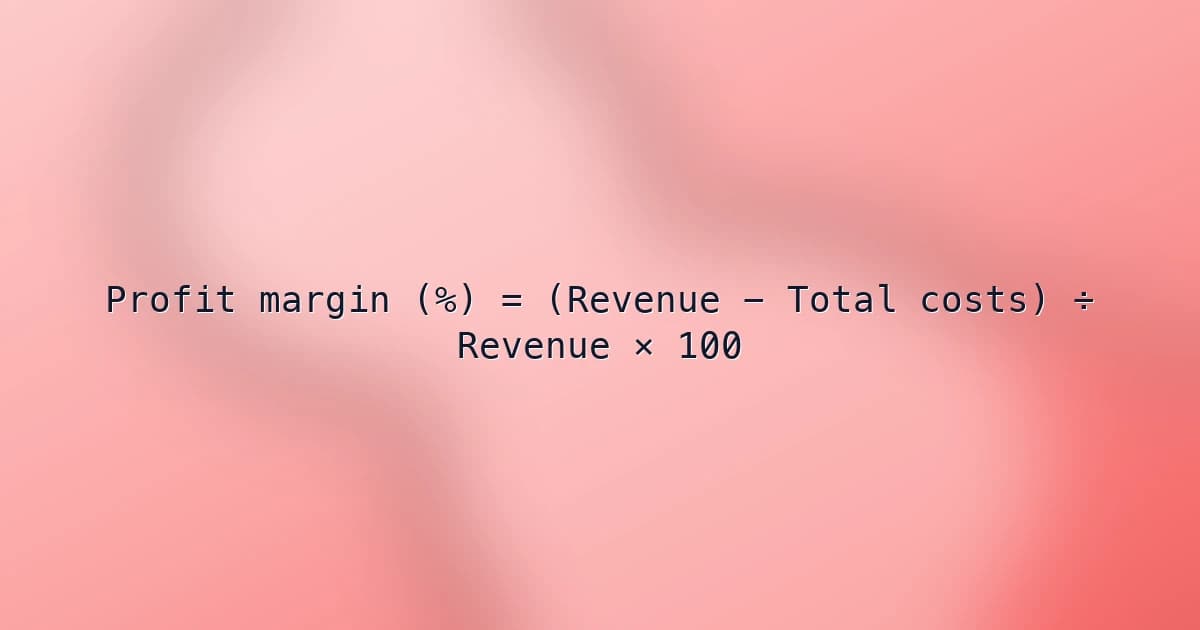
Profit margin formula
Subtract total costs from revenue, divide by revenue, and multiply by 100.
Profit margin (%) = (Revenue − Total costs) ÷ Revenue × 100- Profit = Revenue − Total costs.
- Price for a target margin = Cost ÷ (1 − Target margin). A $68 cost at a 40% margin needs a $113.33 price.
- Gross margin uses only cost of goods sold (COGS). Net margin subtracts all costs, including operating expenses, interest, and taxes.
Inputs explained
Use revenue and costs from the same time period and the same part of the business so the margin reflects real profitability.
- Revenue ($)
- Total sales for the period after refunds, returns, and discounts. Using gross sales before refunds makes your margin look higher than it is.
- Total costs ($)
- All costs for the same period. Include COGS only for gross margin, or add operating expenses such as rent, payroll, marketing, software, and a fair owner salary for net margin.
Example profit margin calculation
A business has $100,000 in revenue and $68,000 in total costs. Profit is $100,000 − $68,000 = $32,000, so profit margin is $32,000 ÷ $100,000 × 100 = 32%. If $40,000 of those costs are COGS, gross margin is 60%. If costs rise 10% to $74,800, margin falls to 25.2%, and prices would need to rise 10% to bring it back to 32%.
Put this calculator on your site
We'll copy this tool into your Calclet account—tweak branding and fields, then paste the embed on WordPress, Webflow, Shopify, or any HTML page. Every embed can link back to Calclet for discovery.
How to use the profit margin calculator
- Input revenue ($) using net sales or recognized revenue consistent with your reporting basis.
- Input total costs ($) using the same scope as revenue whether that is variable-only or fully loaded operating expenses.
- Review net profit margin (%) as profit retained per dollar of revenue.
- Stress-test scenarios by adjusting cost buckets when modeling vendor increases or overhead reductions.
Common profit margin mistakes
- Confusing margin with markup. A 32% margin is a 47% markup on cost.
- Using gross sales instead of revenue after refunds and discounts.
- Leaving out the owner's salary, which makes a small business look more profitable than it is.
- Mixing gross margin and net margin when comparing with competitors or industry benchmarks.
- Treating profit margin as cash flow, which also depends on inventory, receivables, and loan payments.
Net profit margin interpretation context
- Margin versus cash generation
- Accrual net margin differs from operating cash flow when working capital swings, capex, and debt service move cash independently of profit.
- Industry comparability limits
- Margin norms vary widely by sector, capital intensity, and revenue recognition policies; peer comparisons need aligned accounting scopes.
- Cost completeness sensitivity
- Margin expands when costs are understated; governance teams reconcile fully loaded expenses including owner compensation norms.
FAQs
What price should I charge to get a 40% profit margin?
Divide your cost by 1 minus the target margin. A product that costs $68 needs a price of $68 ÷ 0.60 = $113.33 for a 40% margin. Don't just add 40% to the cost: $68 × 1.40 = $95.20 gives only about a 28.6% margin.
My costs went up 10%—how much do I need to raise prices to keep my margin?
Raise prices by the same percentage to keep the same margin. If costs rise from $68,000 to $74,800 on $100,000 of revenue, margin drops from 32% to 25.2%. To restore 32%, revenue must reach $74,800 ÷ 0.68 = $110,000, a 10% price increase at the same sales volume.
How much more do I need to sell to make up for a 10% discount?
More than most people expect. On a $100 item that costs $68, a 10% discount cuts profit per sale from $32 to $22. You need about 45% more sales just to earn the same total profit, and margin falls from 32% to about 24.4%.
How much revenue do I need to make $50,000 in profit?
Divide the profit goal by your margin. At a 32% margin, you need $50,000 ÷ 0.32 = $156,250 in revenue. This assumes your margin stays the same as you grow. Fixed costs often spread over more sales, so margin may improve as revenue rises.
Is cutting costs or increasing sales better for profit?
Compare the revenue needed to match a cost cut. Cutting $5,000 in costs on $100,000 of revenue raises margin from 32% to 37% and profit by $5,000. To earn the same extra $5,000 from new sales at a 32% margin, you'd need about $15,625 more revenue. Cost cuts often pay off faster, as long as they don't hurt quality or growth.
Why is my profit margin high but I still don't feel profitable?
You may be leaving out your own salary. A 32% margin on $100,000 looks strong, but if the owner takes no pay and a fair salary would cost $20,000, the true margin is 12%. Include a market-rate owner salary to see whether the business is really profitable.
What is the difference between gross margin and net profit margin?
Gross margin subtracts only cost of goods sold, while net margin subtracts all costs. With $100,000 in revenue, $40,000 in COGS, and $28,000 in operating expenses, gross margin is 60% and net margin is 32%. A healthy gross margin with a weak net margin usually points to high overhead.
How do I convert profit margin to markup?
Divide margin by 1 minus margin. A 32% margin equals a 0.32 ÷ 0.68 ≈ 47.06% markup on cost. Markup is always higher than margin because it's based on cost rather than selling price, so make sure your team uses the same term when setting prices.
What is my profit margin after taxes?
If your total costs don't include income tax, the calculator shows a pre-tax margin. With $32,000 in pre-tax profit on $100,000 of revenue and a 25% effective tax rate, after-tax profit is $24,000, an after-tax net margin of 24%. Use your own effective tax rate and confirm with your accountant.
What does a negative profit margin mean, and how do I fix it?
It means costs are higher than revenue. With $115,000 in costs on $100,000 of revenue, margin is −15%, a $15,000 loss. Start with your lowest-margin products or customers, raise prices where you can, cut costs that don't drive sales, and track margin monthly until it turns positive.
Related calculators
Related guides
Step-by-step articles on building, embedding, and ranking calculator pages like this one.
Category: Business profitability and pricing educationTopics: Net profit margin, Profitability ratio analysis, Unit economics literacy
Last reviewed: 2026-05-07
Reviewed by: Souhayb Kama Ldine