Monthly management fee revenue
What is property management fee revenue?
Property management fee revenue is the recurring income a property management company earns for managing rental units, usually charged as a percentage of monthly rent. A company managing 280 units at an average rent of $1,450 and an 8.5% management fee earns about $34,510 a month. Property managers use this calculation to forecast revenue, price management contracts, set growth targets, and see how vacancy, rent increases, and fee discounts affect income.
Monthly management fee revenue
Units x average rent x fee%
Embed this free calculator on your website—copy the snippet after signup and keep the Built with Calclet link for attribution (or upgrade to remove branding).
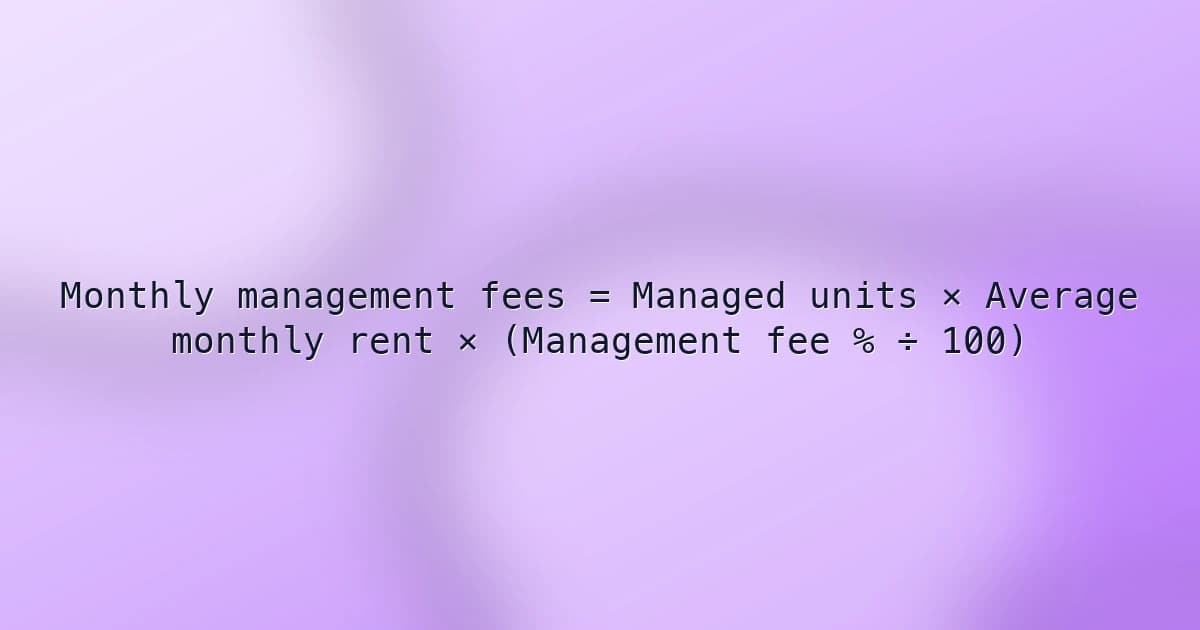
Property management fee formula
Multiply the number of managed units by average monthly rent and the management fee percentage.
Monthly management fees = Managed units × Average monthly rent × (Management fee % ÷ 100)- Fee per door = Average monthly rent × Management fee %.
- Collected-rent fees = Monthly fees × (1 − Vacancy and non-payment rate) when your contract charges on rent actually collected.
- Doors needed for a revenue goal = Target monthly fees ÷ Fee per door.
Inputs explained
Check your management agreements to see whether fees are charged on scheduled rent or collected rent, and which charges are excluded.
- Managed units
- The number of rental units, or doors, you manage that pay a percentage-based management fee. Exclude units on flat-fee contracts or model them separately.
- Average monthly rent ($)
- The average monthly rent across your managed units. Use a weighted average if your portfolio mixes apartments, single-family homes, and commercial space.
- Management fee (%)
- The percentage of monthly rent you charge for ongoing management. Residential fees often fall around 7–10%, but rates vary by market, property type, and portfolio size.
Example property management fee calculation
A property management company manages 280 units with an average rent of $1,450 and charges an 8.5% management fee. Monthly fees = 280 × $1,450 × 0.085 = $34,510, or $123.25 per door. Annual recurring management fee revenue is about $414,120. If your contract charges on collected rent and 6% of rent goes uncollected, fees drop to about $32,439 a month.
Put this calculator on your site
We'll copy this tool into your Calclet account—tweak branding and fields, then paste the embed on WordPress, Webflow, Shopify, or any HTML page. Every embed can link back to Calclet for discovery.
How to use the monthly management fee revenue
- Input managed units from active leases aligned to your fee-eligible portfolio definition.
- Enter average monthly rent ($) as a portfolio-weighted mean or segmented shortcut consistent with your underwriting.
- Set management fee (%) using contractual percentage-of-rent terms net of promotional discounts if excluded.
- Review estimated monthly fees, then layer vacancy-adjusted rent forecasts before publishing annual revenue targets.
Common property management fee mistakes
- Forecasting fees on scheduled rent when contracts charge on collected rent.
- Ignoring vacancy, turnover, and late payments in revenue forecasts.
- Mixing leasing fees, renewal fees, and maintenance markups into the recurring management fee.
- Discounting fees to win large clients without checking the effect on profit per door.
- Growing door count faster than staff capacity, which hurts service and owner retention.
Property management fee modeling context
- Percentage-of-rent conventions
- Residential managers frequently price recurring oversight as a percent of monthly rent, while commercial contracts may blend base fees with reimbursements.
- Rent roll volatility
- Average rent shifts with turnover mix and concessions; portfolio averages require periodic refresh when leasing incentives distort headline rents.
- Fee exclusions
- Many operators exclude third-party vendor invoices and tenant utility reimbursements from percentage bases depending on contract language.
FAQs
How many doors do I need to make $50,000 a month in management fees?
Divide the goal by fee per door. At an average rent of $1,450 and an 8.5% fee, each door earns $123.25 a month, so you need about 406 doors to reach $50,000. Raising average rent or adding leasing and renewal fees lowers the number of doors needed.
Should I charge a flat fee per door or a percentage of rent?
Compare both at your typical rent. An 8.5% fee earns $123.25 per door on $1,450 rent, while a $100 flat fee earns $100. The percentage fee earns more whenever rent is above about $1,176. Many managers use a percentage with a monthly minimum per door so low-rent units still cover the work.
How does vacancy affect my management fee revenue?
If your contract charges on collected rent, vacancy directly cuts fees. At 6% vacancy and non-payment, $34,510 in monthly fees drops to about $32,439, about $2,071 less a month. Faster leasing and tenant screening protect both owner income and your revenue.
How much extra revenue will adding 50 doors bring in?
At $123.25 per door, 50 more units add about $6,163 a month, or about $73,950 a year, taking monthly fees from $34,510 to $40,673. Before signing, check whether you need more staff and whether the new properties are in your service area.
A large owner wants a lower management fee—how much will it cost me?
Calculate the difference across their units. Dropping from 8.5% to 7% on 60 doors at $1,450 rent lowers fees from $7,395 to $6,090 a month, $1,305 less, or $15,660 a year. Consider a volume discount only if larger portfolios save you time, such as buildings in one location.
How much can I earn from leasing and renewal fees on top of management fees?
Estimate them separately from recurring fees. With 280 units and 40% annual turnover, about 112 new leases at a fee of half a month's rent ($725) bring in about $81,200 a year. If the other 168 tenants renew at $150 each, that adds $25,200. Check what your contracts allow.
How many doors can one property manager handle profitably?
It depends on property type and services, but many residential firms plan for somewhere around 100–150 doors per manager. At 140 doors and $123.25 per door, one manager oversees about $17,255 a month in fees, compared with about $6,250 a month for a $75,000 salary. Track doors per manager alongside service quality.
How do rent increases affect my management fee income?
Because fees are a percentage of rent, they rise automatically. A 4% rent increase across 280 units adds about $1,380 a month in management fees without adding doors. Review rents at renewal to keep owners near market rates and grow your revenue.
As a property owner, how much will an 8.5% management fee cost me?
On $1,450 monthly rent, an 8.5% fee is $123.25 a month, or $1,479 a year per unit. Also ask about leasing fees, renewal fees, maintenance markups, and vacancy fees, since these can add significantly to the total cost of management.
Should management fees be charged on scheduled rent or collected rent?
Many residential management agreements charge on rent actually collected, which aligns the manager with the owner. Charging on scheduled rent gives more predictable revenue but is generally less common. Forecast based on what your contracts say, and model vacancy if fees depend on collected rent.
Related calculators
Related guides
Step-by-step articles on building, embedding, and ranking calculator pages like this one.
Category: Property management economicsTopics: Management fee revenue, Units under management, Percentage-of-rent fees
Last reviewed: 2026-05-07
Reviewed by: Souhayb Kama Ldine