Pipeline coverage ratio
What is pipeline coverage ratio?
Pipeline coverage ratio compares the value of qualified sales opportunities with your quota for the same period. A 3x ratio means you have $3 of pipeline for every $1 of quota. Because not every deal closes, you need more pipeline than quota to hit your number. Sales leaders, RevOps teams, and account executives use pipeline coverage to forecast whether a team will hit quota, decide how much new pipeline to generate, and spot risk early in the quarter.
Pipeline coverage ratio
Pipeline value / quota
Embed this free calculator on your website—copy the snippet after signup and keep the Built with Calclet link for attribution (or upgrade to remove branding).
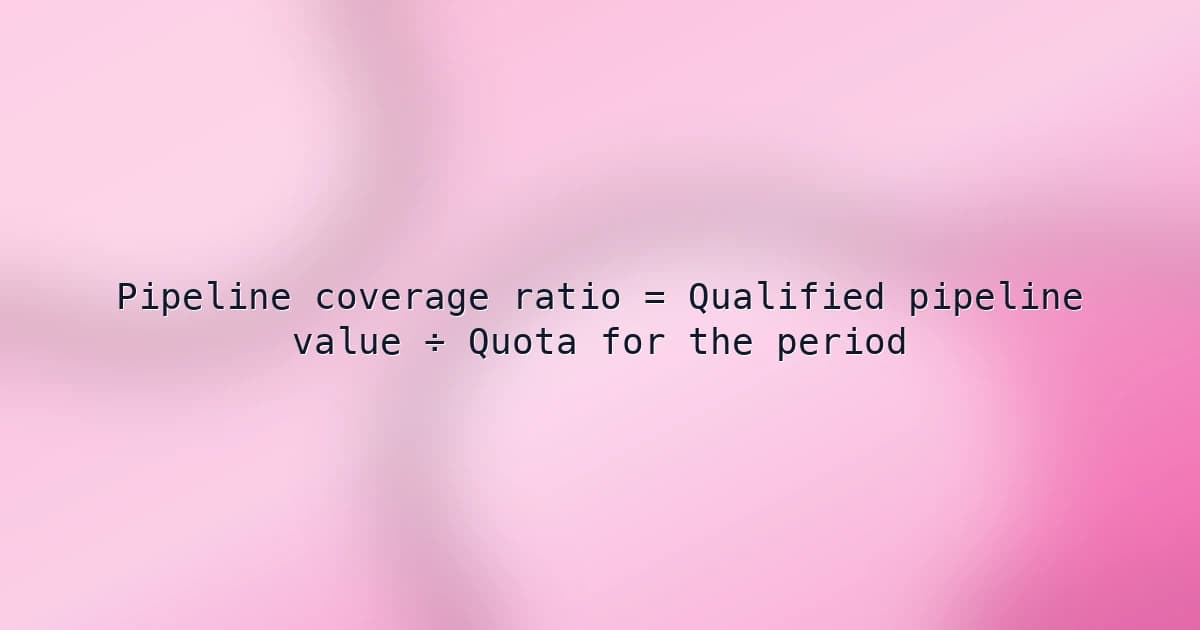
Pipeline coverage ratio formula
Divide qualified pipeline value by quota for the same period.
Pipeline coverage ratio = Qualified pipeline value ÷ Quota for the period- Required coverage = 1 ÷ Win rate. A 25% win rate needs about 4x coverage.
- Expected bookings = Qualified pipeline × Win rate.
- Weighted coverage = Sum of (Deal value × Stage probability) ÷ Quota.
Inputs explained
Include only qualified opportunities expected to close within the same period as the quota.
- Qualified pipeline value ($)
- Total value of qualified opportunities with close dates in the period. Exclude early-stage leads, stale deals, and duplicates.
- Quota for period ($)
- The bookings target for the same period, such as a quarter, for one rep or the whole team. Mid-period, use the quota remaining after deals already closed.
Example pipeline coverage calculation
A sales team has $2,400,000 of qualified pipeline against an $800,000 quarterly quota. Coverage ratio = $2,400,000 ÷ $800,000 = 3.0x, with $1,600,000 of pipeline above quota. At a 28% win rate, expected bookings are $2,400,000 × 0.28 = $672,000, which is 84% of quota.
Put this calculator on your site
We'll copy this tool into your Calclet account—tweak branding and fields, then paste the embed on WordPress, Webflow, Shopify, or any HTML page. Every embed can link back to Calclet for discovery.
How to use the pipeline coverage ratio
- Input qualified pipeline value ($) using CRM definitions your RevOps team audits—typically stage-qualified ACV within forecast categories.
- Input quota for period ($) tied to the same fiscal slice as pipeline close dates, not rolling trailing bookings.
- Read coverage ratio and pipeline minus quota dollars; segment by segment before blending SMB with enterprise forecasts.
- Stress-test lower stages excluded from qualified counts when ratios look inflated versus historical win rates.
Common pipeline coverage mistakes
- Using a fixed 3x target without checking it against your actual win rate.
- Counting early-stage or unqualified deals as pipeline.
- Including deals with close dates outside the quota period.
- Leaving stale or slipped deals in the pipeline.
- Looking only at team coverage while individual reps are short.
Pipeline coverage norms
- Common coverage planning bands
- Enterprise SaaS forecasts frequently target roughly 3–4× pipeline-to-quota early in quarter and compress toward roughly 1× by close depending on win-rate and cycle assumptions.
- Weighted versus gross pipeline
- Coverage ratios balloon when numerators include early-stage discovery; board-ready metrics pair gross coverage with probability-weighted views.
- Period alignment
- Compare pipeline expected to close inside the quota window—calendar quarter—against same-period quota or bookings targets to avoid stale carryover inflation.
FAQs
How much pipeline coverage do I need with a 25% win rate?
Divide 1 by your win rate: 1 ÷ 0.25 = 4x. On an $800,000 quota, you need $3,200,000 of qualified pipeline. With $2,400,000 today, you're $800,000 short, even though 3x is often quoted as a standard target.
We have 3x coverage—will we hit quota?
Only if your win rate is about 33% or higher. At a 28% win rate, $2,400,000 of pipeline produces about $672,000 in bookings, 84% of an $800,000 quota and $128,000 short. Base your coverage target on your historical win rate, not a rule of thumb.
How do I calculate weighted pipeline coverage?
Multiply each deal by its stage probability. $600,000 in late stages at 70%, $800,000 mid-stage at 40%, and $1,000,000 early-stage at 15% give $890,000 of weighted pipeline. Weighted coverage is $890,000 ÷ $800,000 ≈ 1.11x, a more realistic view than the 3x gross figure.
How much new pipeline do we need to create each week to close the gap?
Divide the shortfall by the weeks available. To add $800,000 of pipeline over a 13-week quarter, you need about $61,538 of new qualified pipeline each week. At an average deal size of $40,000, that's 20 new opportunities, or roughly 1.5 a week.
How do I calculate coverage in the middle of the quarter?
Use the quota still remaining. If $350,000 of an $800,000 quota has already closed, $450,000 remains. With $1,200,000 of open pipeline, coverage on the remaining quota is about 2.67x. Compare that with the coverage you need for the time left in the quarter.
Our coverage dropped after a pipeline review—what happened?
Usually stale or slipped deals were removed. Pushing $500,000 of deals into next quarter cuts pipeline from $2,400,000 to $1,900,000, so coverage falls from 3.0x to about 2.38x. That's a more accurate number, so regular pipeline cleanup leads to better forecasts.
Our team has 3x coverage, but some reps are struggling—why?
Team totals can hide gaps. If each of 5 reps has a $160,000 quota, a rep with $300,000 of pipeline has only 1.88x coverage even if the team total is 3x. Check coverage for each rep and move leads or support to those who are short.
Can pipeline coverage be too high?
High coverage can hide poor deal quality. 6x coverage with a 10% win rate still produces only 60% of quota. If coverage is high but bookings are low, tighten qualification and focus reps on deals that can actually close.
Should renewals and expansion deals count in pipeline coverage?
Only if they count toward the same quota. If reps carry a new-customer quota, exclude renewals and upsells from pipeline. Mixing them inflates coverage without making the new-business target easier to hit.
What's a good pipeline coverage ratio?
It depends on your win rate and when in the quarter you measure. Many B2B teams aim for about 3x to 4x at the start of a quarter, with the ratio falling as deals close or drop out. Use 1 ÷ win rate as your baseline, then add a buffer for deals that slip.
Related calculators
Related guides
Step-by-step articles on building, embedding, and ranking calculator pages like this one.
Category: Sales pipeline planningTopics: Pipeline coverage ratio, Quota coverage, Qualified pipeline
Last reviewed: 2026-05-07
Reviewed by: Souhayb Kama Ldine