Estimated gallons needed
What is a paint gallon calculator?
A paint gallon calculator estimates how many gallons of paint you need for a room or project based on paintable wall area, number of coats, and the coverage listed on the paint can. Homeowners and DIY painters use it to buy the right amount of paint for a bedroom, living room, or whole house, and painting contractors use it to quote materials and avoid running short mid-job or overbuying.
Estimated gallons needed
Wall area × coats ÷ labeled coverage
Embed this free calculator on your website—copy the snippet after signup and keep the Built with Calclet link for attribution (or upgrade to remove branding).
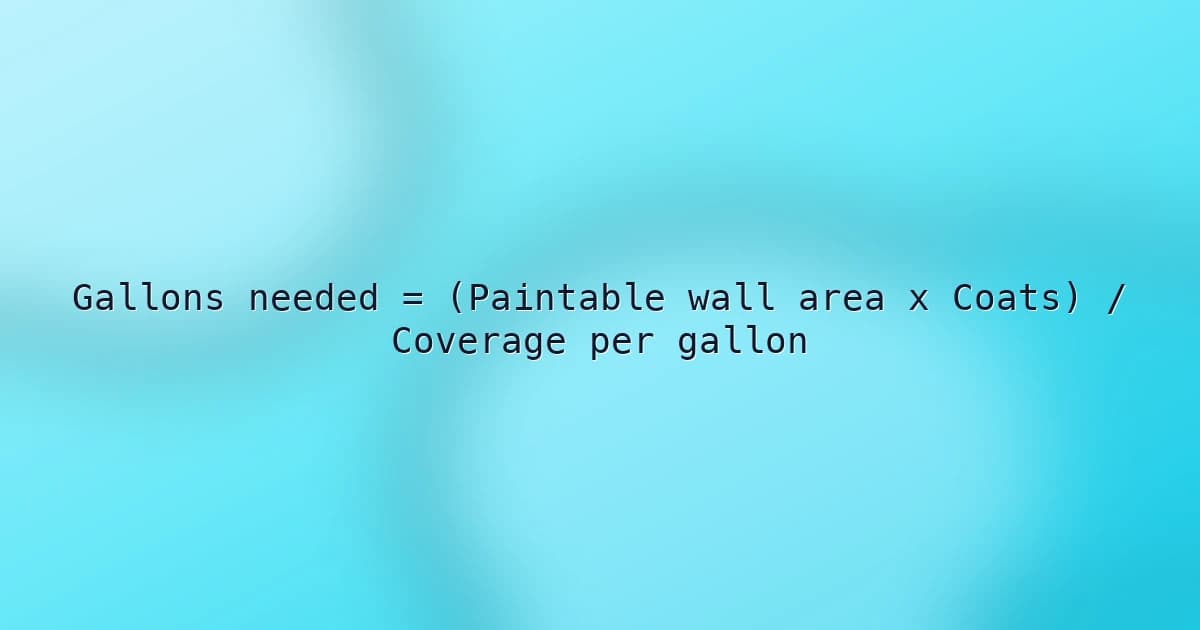
Paint gallon formula
Multiply the paintable wall area by the number of coats, then divide by the coverage per gallon on the paint label. Round up to the nearest gallon or quart when buying.
Gallons needed = (Paintable wall area x Coats) / Coverage per gallon- Wall area = Room perimeter x Wall height; perimeter = 2 x (Length + Width).
- Paintable area = Wall area - Windows and doors (about 15 sq ft per window and 21 sq ft per door are common estimates).
- One quart = 0.25 gallon; a 5-gallon bucket is often cheaper per gallon for larger jobs.
Inputs explained
Measure walls carefully and use the coverage rate from the specific paint you plan to buy.
- Paintable wall area (sq ft)
- Total wall area you will paint, minus windows, doors, and other areas you will not paint. For a 12 x 14 ft room with 8 ft ceilings, the walls are 52 ft x 8 ft = 416 sq ft before openings. Calculate ceilings and trim separately if you use a different paint.
- Coats
- Two coats is standard for most repaints and gives even color. Use three coats or add primer when covering dark colors, painting bare drywall, or making a big color change.
- Label coverage (sq ft / gallon)
- Coverage printed on the can or the product data sheet, often around 350 to 400 sq ft per gallon for interior paint on smooth walls. Use a lower number, such as 250 to 300, for textured, porous, or unprimed surfaces.
Example paint gallon calculation
A repaint covers 1,420 sq ft of wall area with two coats, using paint that covers 350 sq ft per gallon. Gallons needed = (1,420 x 2) / 350 = about 8.11 gallons. Rounding up, you would buy 9 gallons, or one 5-gallon bucket plus 4 gallons, leaving about 0.89 gallon for touch-ups. At $45 a gallon, paint costs about $405.
Put this calculator on your site
We'll copy this tool into your Calclet account—tweak branding and fields, then paste the embed on WordPress, Webflow, Shopify, or any HTML page. Every embed can link back to Calclet for discovery.
How to use the estimated gallons needed
- Measure or sum paintable wall area (sq ft) after excluding fixed openings you will not coat or account separately.
- Input coats based on primer steps, manufacturer recommendations, and whether you are covering bold colors.
- Set label coverage (sq ft per gallon) from the specific product Technical Data Sheet for your roller nap and substrate.
- Review approximate gallons (buy ceiling), then round up to purchasable cans and reserve material for touch-ups.
Common paint estimating mistakes
- Using floor square footage instead of wall area.
- Forgetting to subtract windows and doors, or subtracting them twice.
- Planning one coat when changing colors or painting over patched walls.
- Using label coverage on textured or porous surfaces, which absorb more paint.
- Buying exactly the calculated amount with nothing left for touch-ups.
- Mixing paint from different batches mid-wall, which can cause slight color differences.
Interior paint coverage planning context
- Manufacturer coverage variance
- Printed coverage depends on substrate porosity, roller nap, application thickness, and whether surfaces are primed; porous drywall or repairs often consume more product than label optimism.
- Sheen and color-change effects
- Deep color transitions and low-sheen finishes frequently warrant extra coats compared with like-over-like maintenance painting.
- Buy rounding practice
- Retail purchasing commonly rounds gallons up and keeps leftover inventory for touch-ups rather than risking mid-job shortages.
FAQs
How much paint do I need for a 12x14 bedroom?
With 8 ft ceilings, the walls measure 2 x (12 + 14) x 8 = 416 sq ft. Subtract two windows (about 15 sq ft each) and one door (about 21 sq ft) to get about 365 sq ft. Two coats at 350 sq ft per gallon need about 2.09 gallons, so buy 2 gallons plus a quart. The ceiling adds about 168 sq ft, roughly 1 more gallon for two coats.
How much paint do I need to cover a dark color with a lighter one?
Plan for primer plus two coats, or three coats of paint. On 1,420 sq ft, one coat of primer at 300 sq ft per gallon needs about 4.73 gallons, plus 8.11 gallons for two topcoats. Without primer, three coats need about 12.17 gallons. A tinted primer often saves a coat and costs less than an extra coat of premium paint.
Why did I run out of paint before finishing the room?
Textured, porous, or patched walls absorb more paint than the label assumes, and thick rollers hold more paint. On 1,420 sq ft with two coats, real coverage of 300 instead of 350 sq ft per gallon raises the need from about 8.11 to 9.47 gallons. Use a lower coverage rate for textured walls and add about 10% extra.
Should I buy 5-gallon buckets or single gallons?
For jobs over about 5 gallons, a 5-gallon bucket is usually cheaper per gallon and keeps color consistent. For 8.11 gallons, one 5-gallon bucket plus four single gallons covers the job with a little left over. If a 5-gallon bucket costs $200 versus $225 for five singles, you save about $25 per bucket.
How much paint should I buy extra for touch-ups?
Round up to the next whole gallon, which usually leaves enough for touch-ups. Buying 9 gallons for an 8.11-gallon job leaves about 0.89 gallon. For small rooms, an extra quart is often enough. Label leftover paint with the room and date, and store it sealed away from freezing temperatures.
How much will it cost to paint a room or house?
Multiply gallons by price per gallon. At 9 gallons, mid-range paint at $45 a gallon costs about $405, while premium paint at $70 a gallon costs about $630. Add primer, rollers, brushes, tape, and drop cloths. Premium paint can sometimes cover in fewer coats, which offsets part of the higher price.
How much paint do I need for exterior siding?
Exterior surfaces like wood siding or stucco usually cover less than interior drywall. For 2,200 sq ft of siding with two coats at about 300 sq ft per gallon, you need about 14.67 gallons, so buy three 5-gallon buckets. Rough stucco or bare wood can need even more, so check the product data sheet.
Does paint-and-primer-in-one mean I only need one coat?
Usually not. Paint-and-primer products can improve coverage and hide, but most manufacturers still recommend two coats for even color, especially over dark colors, patches, or new drywall. Estimate two coats unless you are repainting the same color over a clean, sound surface.
How much paint do I need for trim and baseboards?
Trim usually needs far less paint. Baseboards around a 12 x 14 room are about 52 linear feet; at about 6 inches tall, that is about 26 sq ft, or about 0.15 gallon for two coats. One quart covers roughly 87.5 sq ft at 350 sq ft per gallon, enough for trim in most single rooms.
How do I make sure the color matches across multiple gallons?
Buy all the paint at once from the same batch if possible, and mix (box) the gallons together in a larger bucket before you start. Boxing paint blends small color differences between cans so walls look uniform, which is especially important when using several single gallons instead of a 5-gallon bucket.
Related calculators
Related guides
Step-by-step articles on building, embedding, and ranking calculator pages like this one.
Category: Interior painting takeoffs and materialsTopics: Paint coverage estimate, Gallons per job, DIY painting planning
Last reviewed: 2026-05-07
Reviewed by: Souhayb Kama Ldine