Estimated gross ad revenue
What is a YouTube revenue estimator?
A YouTube revenue estimator approximates how much ad revenue a channel earns each month from its views. It multiplies monthly views by the share that show ads and by the revenue per 1,000 monetized views. Creators, managers, and brands use it to forecast income, compare niches, set sponsorship rates, and plan channel growth. The result is gross ad revenue before YouTube's share, and it excludes sponsorships, memberships, and merchandise.
Estimated gross ad revenue
Illustrative — actual Studio analytics vary
Embed this free calculator on your website—copy the snippet after signup and keep the Built with Calclet link for attribution (or upgrade to remove branding).
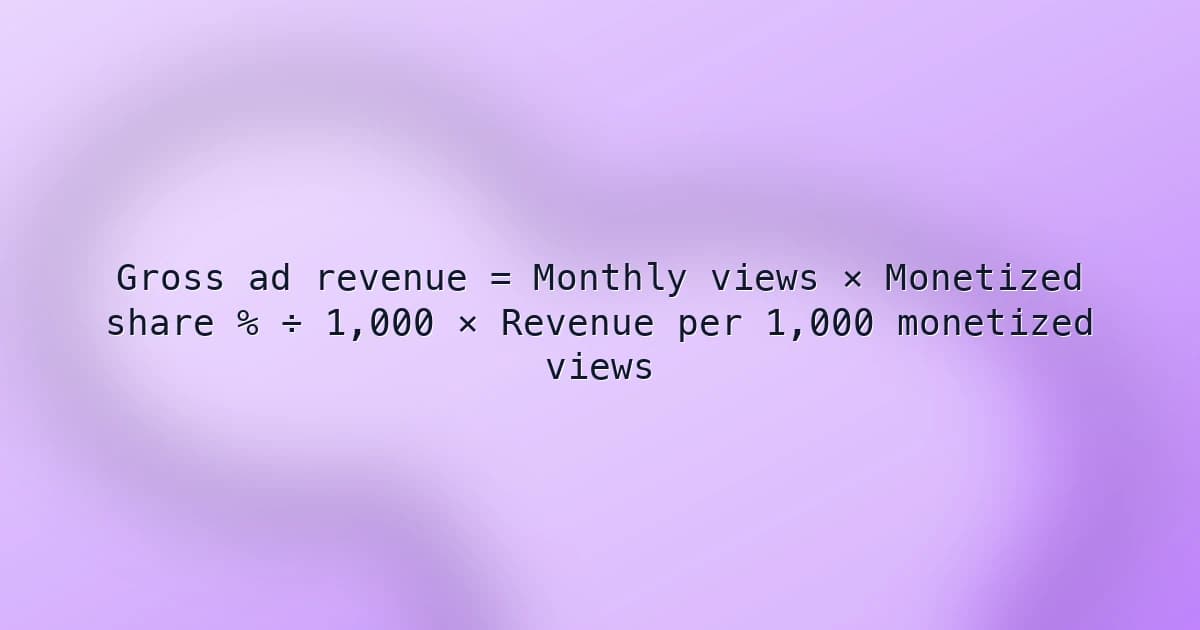
YouTube revenue formula
Multiply monetized views (in thousands) by the revenue earned per 1,000 monetized views.
Gross ad revenue = Monthly views × Monetized share % ÷ 1,000 × Revenue per 1,000 monetized views- For long-form videos, YouTube typically pays creators 55% of ad revenue, so estimated payout ≈ Gross × 0.55.
- YouTube Studio's playback-based CPM is closest to the gross rate used here; Studio's RPM is already after YouTube's share.
- Rates vary widely by niche, viewer country, season, and video format.
Inputs explained
Take figures from YouTube Studio analytics, ideally averaged over the last 90 days to smooth out viral spikes.
- Monthly monetized-play views
- Views per month on videos that are eligible to show ads.
- Share of views that earn ads (%)
- Percentage of views that actually show an ad, after ad blockers, limited ads, and unfilled ad slots.
- Blended RPM ($)
- Gross ad revenue per 1,000 monetized views. If you enter Studio's RPM instead, treat the result as a rough, slightly understated payout rather than gross revenue.
Example YouTube revenue calculation
An education channel gets 890,000 monthly views, 78% of which show ads, at $9.50 per 1,000 monetized views. Monetized views = 694,200, so gross ad revenue = 694.2 × $9.50 = about $6,595 a month. At a 55% creator share, the estimated payout is about $3,627.
Put this calculator on your site
We'll copy this tool into your Calclet account—tweak branding and fields, then paste the embed on WordPress, Webflow, Shopify, or any HTML page. Every embed can link back to Calclet for discovery.
How to use the estimated gross ad revenue
- Pull monthly monetized-play eligible views from YouTube Studio revenue analytics—avoid raw channel views if large portions come from non-monetized surfaces.
- Tune share of views that earn ads using monetized playbacks divided by total views for similar cohorts—lift sliders when limited-ad impressions spike.
- Set blended RPM using Revenue ÷ (monetized playbacks / 1000) from Studio exports so sliders mirror geography-aware realized yields.
- Compare rough monthly gross against payout deposits remembering taxes, MCN splits, and withholding happen downstream.
Common YouTube revenue estimate mistakes
- Confusing gross ad revenue with the creator's payout after YouTube's share.
- Mixing up CPM (advertiser cost) with RPM (creator earnings per 1,000 views).
- Using long-form rates for Shorts views.
- Basing forecasts on one viral month or a high-paying Q4.
- Forgetting tax withholding and income from sponsorships or memberships.
YouTube revenue estimation hygiene
- Gross versus creator payout
- AdSense statements reflect gross receipts subject to platform revenue-sharing policies—model net deposits separately once Finance reconciles Google payouts.
- RPM volatility drivers
- Advertiser demand, seasonality, niche advertiser pools, and viewer geography swing RPM materially—smooth trailing ninety-day blends instead of single viral spikes.
- Format mixes
- Shorts monetization mechanics differ from long-form auction RPM—split sliders when catalog mixes vertical feeds with traditional uploads.
FAQs
How much does YouTube pay for 1 million views?
It varies widely by niche and audience. At 78% of views showing ads and $9.50 per 1,000 monetized views, 1 million views earns about $7,410 gross, or about $4,076 after YouTube's typical 45% share on long-form videos. Low-rate niches may earn a fraction of that.
How many YouTube views do I need to earn $5,000 a month?
Work backward from your payout. $5,000 ÷ 0.55 = about $9,091 gross. At 78% monetized and $9.50 per 1,000, that needs about 1.23 million monthly views.
How much of the estimated revenue will I actually receive?
For long-form videos, creators typically get 55% of ad revenue. A $6,595 gross estimate becomes about $3,627 before taxes. Shorts revenue is shared differently, so estimate it separately.
How much does my YouTube niche change earnings?
A lot. With the same 890,000 views and 78% monetized, a $25 rate (common in finance or business niches) earns about $17,355 gross, while a $4 rate (common in gaming or entertainment) earns about $2,777. Rates are examples only; check your own analytics.
Why does YouTube revenue rise in Q4 and drop in January?
Advertisers spend more before the holidays and less in January. If your $9.50 rate rises 30% to $12.35, revenue climbs to about $8,573; if it drops to $7 in January, it falls to about $4,859. Plan using a full-year average.
How much do YouTube Shorts pay compared with long videos?
Shorts usually earn far less per view. At an assumed $0.08 per 1,000 views, 2 million Shorts views earn about $160, while long-form rates are often several dollars per 1,000. Estimate Shorts and long-form revenue separately.
How do ad blockers and limited ads affect YouTube revenue?
They reduce the share of views that show ads. If it falls from 78% to 60% on 890,000 views at $9.50, gross revenue drops from about $6,595 to $5,073. Keeping videos advertiser-friendly helps protect it.
How do I estimate my yearly YouTube income?
Multiply monthly revenue by 12, adjusting for seasonality. $6,595 gross a month is about $79,139 a year, or about $43,526 after a 55% creator share, before taxes and before income from sponsorships or memberships.
How does US tax withholding affect non-US YouTubers?
YouTube may withhold US tax on earnings from US viewers, at rates up to 24% or 30% depending on your tax information and tax treaties. If 40% of a $3,627 payout comes from US viewers and 24% is withheld, that's about $348. Check your local tax rules.
Should I charge more for a sponsorship than I earn from ads?
Usually yes. A video with 100,000 views earns about $741 gross from ads, or about $408 after YouTube's share. A sponsor paying $20 per 1,000 views would pay $2,000 for the same video, so sponsorships often earn several times more than ads.
Related calculators
Related guides
Step-by-step articles on building, embedding, and ranking calculator pages like this one.
Category: YouTube Partner Program economicsTopics: Effective RPM modeling, Monetized playback share, Gross advertising revenue
Last reviewed: 2026-05-07
Reviewed by: Souhayb Kama Ldine